
 Tiếng Việt


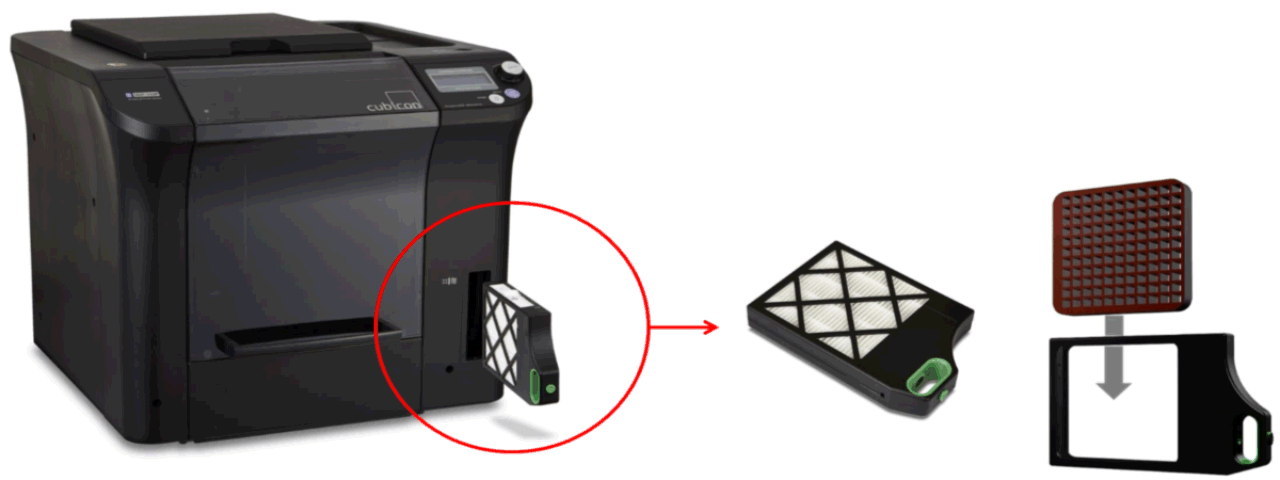
The Cubicon 3D printer ( affordable imported 3D printer) is the first 3D printer line in Vietnam with a filter system for the toxic fumes released when plastic is melted. It is safe for users’ health and kinder to the environment.
Cubicon 3D printer
This 3D printer line is developed by HyVISION, made 100% in Korea and distributed exclusively in Vietnam by 3D Vietnam. Cubicon printers stand out for their software, design and special features, and the toxic fume filter system is one of them. Until now, 3D printer makers have focused only on what their machines can do, their output and part quality, and paid little attention to user health or the environment. Seeing this gap, the trusted 3D printer maker HyVISION developed the first 3D printers with a toxic fume removal system: the Cubicon line, including the Cubicon Single, Cubicon Single Plus and Cubicon Style.
Odor filter system of the Cubicon Single 3D printer
The filter is neatly built into the machine and easy to remove and replace. Its main component is activated carbon. Thanks to the enclosed build chamber, the circulating airflow lets the system work as efficiently as possible.
In short:
Contact us now for advice!There are many factors to weigh when choosing a 3D printer for yourself, your company or your family. We understand that. Besides the benefits a printer brings, price is an important, very important, issue. But your health, the health of your staff, and the health of your family and loved ones matter many times more. You are a manager and a smart buyer. I trust you will make the right decision.
| INFORMATION | 3D Vietnams Company – 3D Vietnam |
| Phone | 0975 008 728 |
| Mobile | 0975 008 728 |
| contact@ct3dgroup.com | |
| Address | 7749 Vo Van Ngan, Ho Chi Minh City. |
Contact CT3D Group
CT3D Group – Professional 3D printing, 3D scanning, design and rapid prototyping services nationwide.
- CT3D Thu Duc – Ho Chi Minh City, Hanoi, Hai Phong: in3d.edu.vn – Hotline 0975 008 728 (Mr. Thai)
- CT3D District 6 – Ho Chi Minh City: 3dmaker.vn – Hotline 038 7798308 (Mr. Phuc)
Why should FDM 3D printing users care about fumes and ultrafine particles?
When plastic is melted in the nozzle of an FDM 3D printer, the process can release ultrafine particles (UFPs) and volatile organic compounds (VOCs). Emission levels depend heavily on the plastic and print temperature: ABS and ASA usually smell strongly and emit more, while PLA smells less but still produces ultrafine particles. A single printer in a large, well-ventilated room has little effect, but when many printers run nonstop in a closed room such as a classroom or office, the buildup can be significant. That is why features like enclosed build chambers and air filters are getting more attention.
Ways to reduce emissions when 3D printing
| Solution | Effect | Note |
|---|---|---|
| Enclosed build chamber | Keeps temperature stable and limits fumes and particles escaping into the room | Needs a filter or exhaust; otherwise fumes still escape when the door is opened |
| HEPA filter | Captures ultrafine particles | Replace the filter cartridge as recommended |
| Activated carbon filter | Absorbs odors and some VOCs | Carbon saturates over time and must be replaced |
| Outdoor exhaust | Most effective for workshops with many printers | Requires ducting; avoid cold drafts that warp parts |
Safe habits for placing and running a 3D printer
- Do not put the printer in a bedroom or where young children spend a lot of time.
- Prefer PLA in classrooms and offices; avoid printing ABS without a filter or exhaust system.
- Print at the filament maker’s recommended temperature; too much heat can make the plastic break down.
- Wait a few minutes for the machine to cool and the fumes to settle before opening the chamber door.
- Clean and replace filters regularly and keep the room ventilated.
For high-volume printing or engineering materials with heavy emissions, a safer and cheaper option is to have parts printed at a professional workshop with proper ventilation. Check out CT3D Group’s 3D printing service so you don’t have to run printers in your workspace.
Frequently asked questions
Is printing with PLA toxic?
PLA is considered one of the lower-odor, safer 3D printing plastics, but it still releases ultrafine particles while printing. So you should still keep the printer in a well-ventilated place and avoid sitting right next to it for long periods.
Is an enclosed 3D printer safe enough?
An enclosure limits fumes and particles spreading into the room, but it does not remove them. To be effective, an enclosure should be paired with a HEPA filter, activated carbon or an exhaust duct to the outside.
How often should a 3D printer’s air filter be replaced?
It depends on print hours and the plastic used, and usually follows the printer maker’s recommendation. If the plastic smell gets stronger than before while the machine runs normally, the carbon filter is saturated.
What should I keep in mind when placing a 3D printer in a classroom?
Choose an enclosed printer with an air filter, prefer PLA and put the printer in a ventilated spot away from students’ seats. Teachers should also tell students not to touch the nozzle or heated bed while the printer is running.
Related services at CT3D Group
- Custom 3D printing service
- High-accuracy 3D scanning service
- Custom 3D design service
- CT3D Group network: ct3dgroup.com · in3d.edu.vn – Hotline/Zalo 0975 008 728

