
 Tiếng Việt


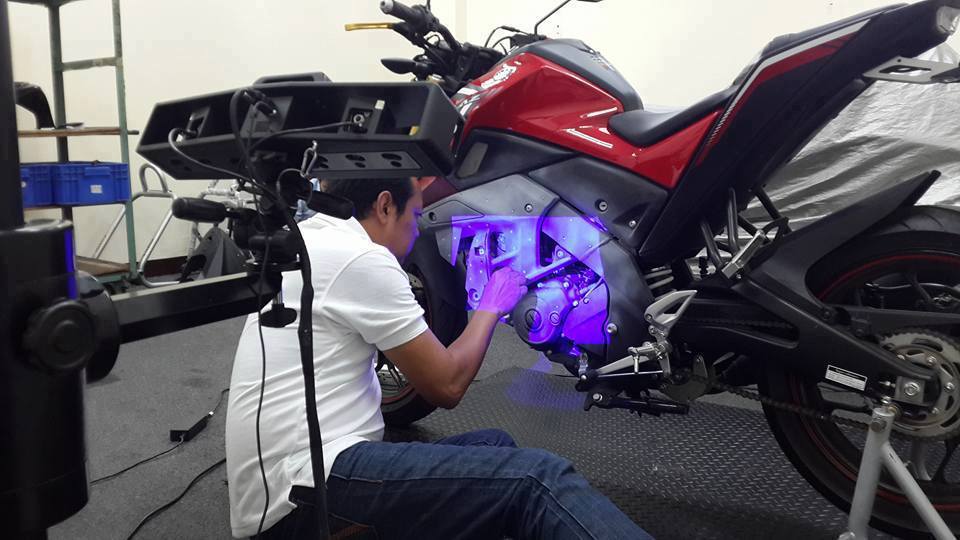
Reverse engineering is the most common use for 3D scanners. So how does a 3D scanner actually work in practice to make reverse engineering possible?
3D scanners | Reverse engineering
There are many kinds of 3D scanners on the market, so which ones can really be used for reverse engineering? In practice, any 3D scanner that captures complete 3D data as a point cloud or mesh file (STL, OBJ) works well for reverse engineering. But depending on how accurate the product needs to be, we choose a high-accuracy 3D scanner to capture high-quality data from the sample. When the scan data is high quality, the reverse engineering process produces a 3D file (STP, STEP, X_T, IGS…) that matches the sample as closely as possible and reaches high accuracy.
The 3D scanning process – 3D scanner
Most 3D scanning technology is light-based, and it’s this technology that can produce high-quality scan data for reverse engineering plastic parts such as body panels, lights and toy vehicles… and even cars and motorbikes. The device shown above is the Eascan D 3D scanner from Shining 3D.
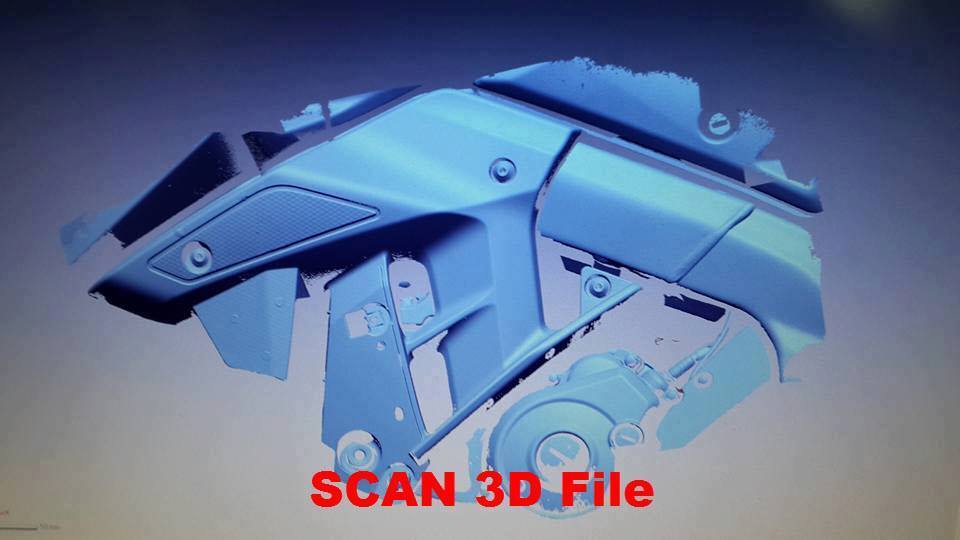
STL mesh data from a 3D scanner
The image above shows mesh data created by a 3D scanner. Complete, sharp mesh data makes the reverse engineering step that follows easier and more accurate.

Data after reverse engineering, as a solid (solids or surfaces)
This data can be used for many purposes:
- CNC machining programming.
- 3D printing (rapid prototyping).
- Mold splitting and mold design
- …
Nguyen Van Cuong
Image source: Scan 3D in Thailand
Contact CT3D Group
CT3D Group – professional 3D printing, 3D scanning, design and rapid prototyping services nationwide.
- CT3D Thu Duc – Ho Chi Minh City, Hanoi, Hai Phong: in3d.edu.vn – Hotline 0975 008 728 (Mr. Thai)
- CT3D District 6 – Ho Chi Minh City: 3dmaker.vn – Hotline 038 7798308 (Mr. Phuc)
The reverse engineering workflow from 3D scan data
Going from STL mesh data to a CAD file ready for production takes a chain of work that requires an engineer who understands both the part and how it will be used. A standard workflow usually includes:
- Mesh processing: remove noise, fill holes and smooth in a controlled way so important details aren’t lost.
- Coordinate alignment: set the part’s datum planes and axes so the CAD model has a sensible origin for machining and assembly.
- Surface segmentation: the software automatically detects flat, cylindrical, conical and freeform regions as a basis for modeling.
- Modeling: sketch profiles from mesh cross-sections, build solids with extrude, revolve and loft, and build freeform surfaces for complex areas.
- Deviation check: compare the CAD model with the scan data using a color map, and fix areas that are out of tolerance.
- File export: STEP, IGES, Parasolid or the native CAD format as required.
Two approaches to reverse engineering: exact copy or redesign
| Approach | Goal | When to use it |
|---|---|---|
| Exact copy (as-built) | The model follows the sample’s real shape closely, including small deformations | Artistic parts, plastic covers that must fit existing assemblies, as-is archiving |
| Redesign to design intent | Restore nominal dimensions: truly flat faces, perfectly round holes, true right angles | Mechanical parts to be remanufactured, mold making, technical drawings |
Choosing the right approach from the start avoids wasted rework and makes sure the final file suits its purpose, whether that’s CNC machining, 3D printing or mold splitting.
What determines the quality of a reverse engineered file
Scan data quality is the foundation: missing or noisy data forces the engineer to guess more. Next comes experience with product structure, such as draft angles on plastic parts or fit datums on mechanical parts. If you need to turn a physical part into a production CAD file, take a look at our reverse engineering service from 3D scan data for advice on the right level of accuracy.
Frequently asked questions
Which 3D scanners are suitable for reverse engineering?
Any scanner that captures complete mesh or point cloud data can be used for reverse engineering, but its accuracy should match the part’s tolerances. Tight-fitting mechanical parts need a more accurate scanner than artistic pieces.
How long does it take to reverse engineer a part?
It depends on the part’s complexity, the quality of the scan data and the accuracy required. Simple geometric parts can be done quickly, while parts with many freeform surfaces, like vehicle body panels, take longer.
Can I edit the dimensions in a reverse engineered file?
Yes. If the model is built parametrically in CAD software, you can change dimensions and add or remove features like any normal design. That’s a big difference from an STL mesh file, which is only for printing or viewing.
Is reverse engineering a copyright violation?
Reverse engineering is a legal technique when used to replace your own parts, make improvements or archive, but copying a product protected by a design or patent for commercial use may break the law. Businesses should check protection status before commercializing.
Related services at CT3D Group
- Reverse engineering service
- 3D scanning service – high-accuracy 3D scanning
- Custom 3D design service
- CT3D Group network: ct3dgroup.com · in3d.edu.vn – Hotline/Zalo 0975 008 728

