
 Tiếng Việt



A customer once brought her feet into our workshop. The left and right were clearly different. She said she had never bought a pair of shoes that fit both sides. She always sized up for the bigger foot and stuffed an extra insole in the other shoe. We scanned both feet, rebuilt the models and printed a test pair of insoles, one for each side. Since that day I’ve believed that personalization in fashion doesn’t start with the printer. It starts with body data.
Three stories stood out in the past few weeks: slides sold as print files, 3D-printed titanium eyewear temples, and a 3D-printed dress so striking that the woman wearing it couldn’t walk.

Sneakprint: selling fit, not slides
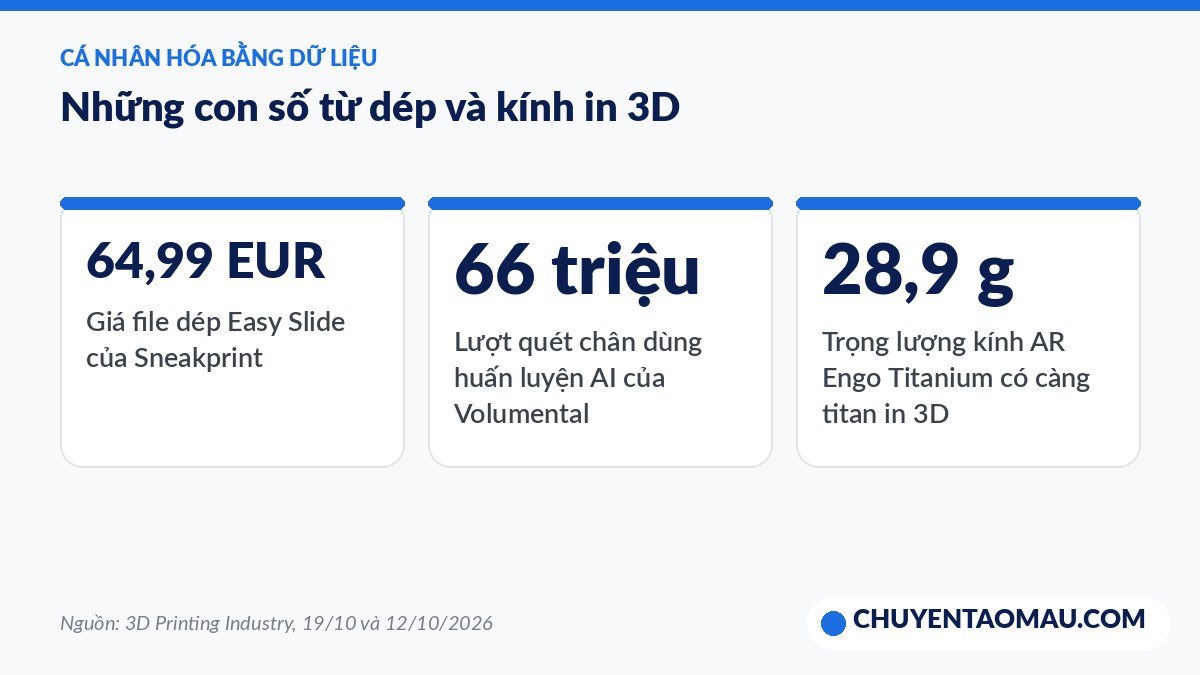
According to 3D Printing Industry, Munich footwear startup Sneakprint has launched a platform called ShoeFactory. Instead of shipping finished shoes, it sells files. Customers scan their feet with a phone, adjust a parametric design in the browser, then get a set of STL files to print on their own 3D printer at home. The first model is the Easy Slide, priced at 64.99 EUR.
What I find interesting is how they handle the data:
- No scan, no sale. You can only place an order once a foot scan is attached to the cart.
- Left and right feet are built separately, because two feet are rarely identical.
- Scanning needs no app. Users photograph each foot on a plain sheet of paper for scale. The scanning tech comes from Volumental, which says its AI was trained on 66 million real scans and measures foot length, width and shape to the millimeter.
- 90 days to customize: sole thickness, width, height, lattice density and the text on the strap. Once approved, the STL files arrive by email in one to two minutes.
Before this, Sneakprint sold made-to-measure leather shoes for 249 EUR, with 3D-printed insoles based on each person’s plantar pressure. ShoeFactory keeps the same scan-to-geometry pipeline and simply hands production over to the customer.
The article also points out a weak spot: the platform doesn’t yet give guidance on materials or printer requirements, while a wearable slide sole usually needs flexible filament and carefully tuned print settings. Anyone who has printed TPU knows this: the same file printed on two different machines can feel very different underfoot. That’s where print service shops still have room to grow.
Eyewear: 3D-printed titanium because every gram counts
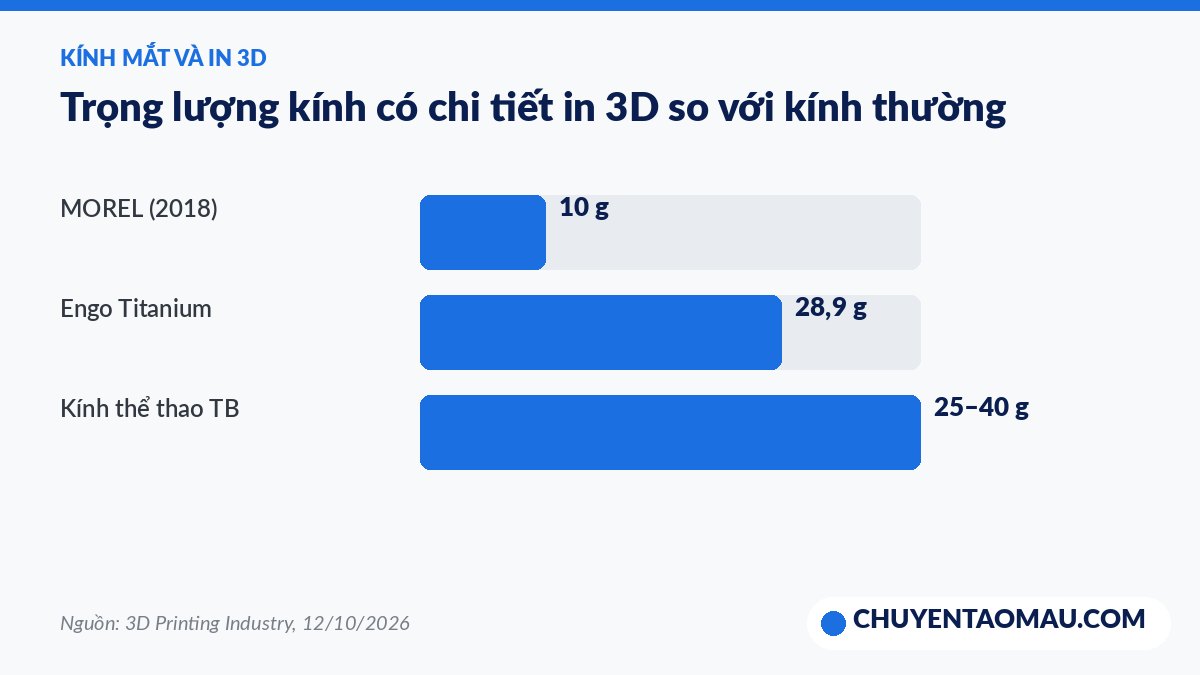
On the eyewear side, 3D Printing Industry reports that Engo Eyewear has launched Engo Titanium, augmented reality (AR) glasses for runners and cyclists with two temples made from metal 3D-printed titanium. The whole pair weighs 28.9 g, while regular sports glasses with no smart features already weigh 25–40 g on average. To keep the weight down, the company dropped the camera, audio and AI entirely, keeping only a color display with more than 40 training metrics such as heart rate, pace and cadence.
The article also mentions a precedent: since 2018, French eyewear brand MOREL has sold glasses with SLS-printed nylon frames and titanium temples, weighing just 10 g in total.
The temple arms press against the sides of the head and behind the ears, and that’s what you feel most after a few hours of wear. Head width and ear position vary from person to person, so this is an ideal part to build from face scan data once the cost of printing titanium comes down.
When design forgets the human body
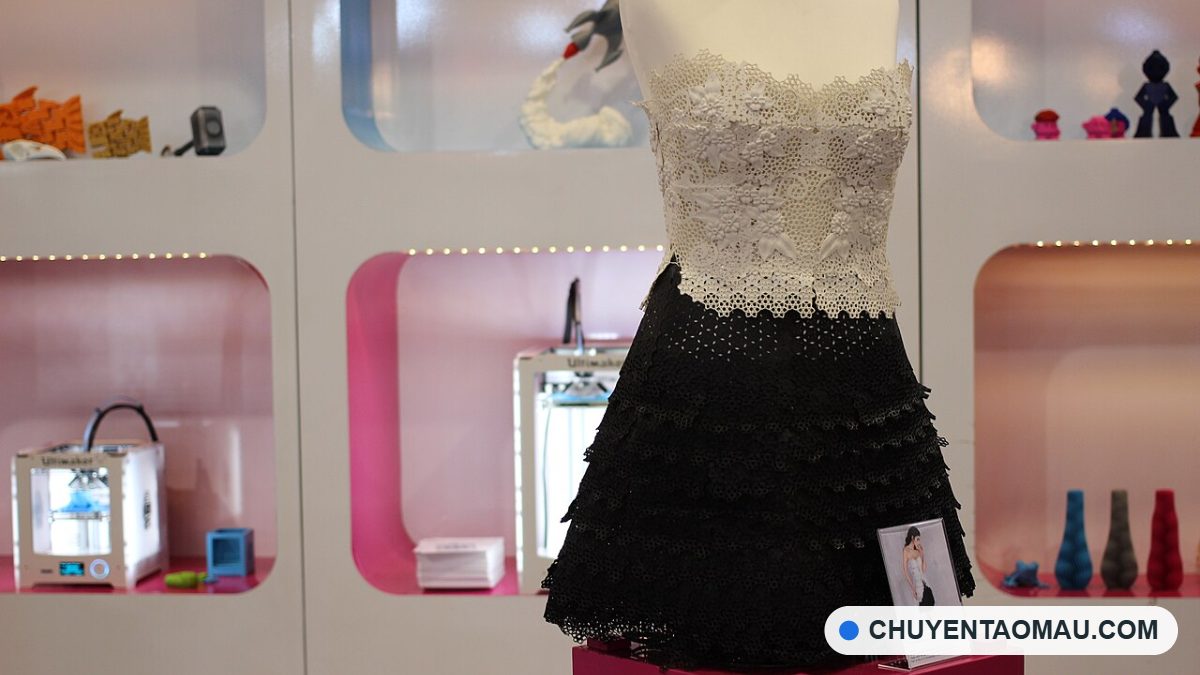
On the flip side, VnExpress reported that actress Qi Wei wore a 3D-printed dress mimicking a splash of water at a fashion show in Wuhan on September 25. The team used AI to design it and made it from clear plastic. The dress had no stretch and weighed 16 kg, so she couldn’t move on her own and had to stand on a trolley to get onto the stage.
Visually, it was stunning. Technically, it’s a textbook case of ignoring ergonomics. Rigid material, heavy mass, and no joints or soft zones to let the body move. Wearable 3D-printed garments usually have to be split into many small linked pieces, or use a thin mesh made of flexible material. The lesson is the same as with the slides: good-looking geometry isn’t enough. It has to be built from, and for, the human body.
Vietnam’s footwear and jewelry industries from an engineer’s view
Footwear is a well-established manufacturing industry in Vietnam, but many companies still mostly work from existing designs and purchase orders. According to VnExpress, Ho Chi Minh City’s supporting industries development program for 2026–2030 targets a localization rate above 65% for footwear by 2030. The city also plans to work with training schools on molds, automation, 3D printing and IoT, aiming to upskill at least 50 companies a year.
From what I’ve seen working with shoe sample workshops and jewelers, there are a few directions you can try right away without a big investment:
- Insoles and soles built from foot scan data. This is the easiest product to commercialize, serving both athletes and people with foot problems.
- Quick prints of lasts and sole samples for design approval. This shortens the back-and-forth of sending samples to clients.
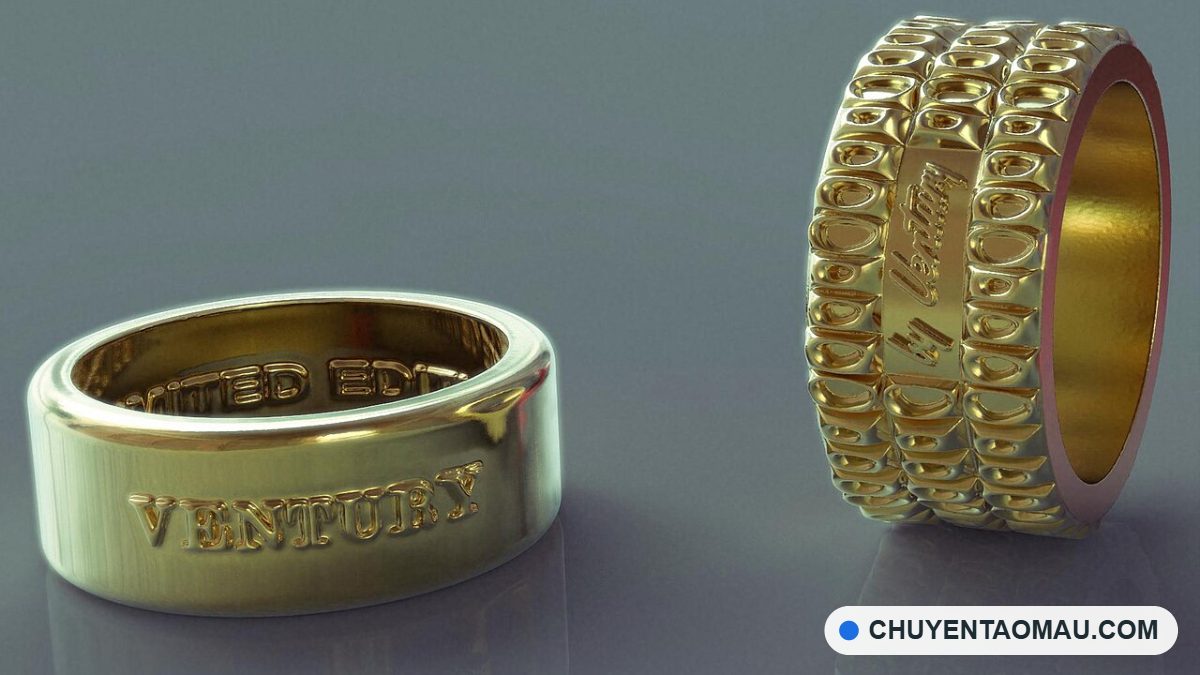
- Custom jewelry. Rings sized from a finger scan, pendants with engraved names or complex geometry can be printed as casting patterns in special resin, then cast in precious metal using the traditional process.
- Sell fit data, not just finished products. Sneakprint’s model suggests that what holds long-term value is the pipeline from scan to parametric geometry.
The hardest part isn’t the printer. The step that decides everything is turning scan data into a clean, accurately sized model that can be rebuilt from parameters. A foot scan that’s off by a few millimeters will produce insoles that hurt, no matter how well they’re printed.


Personalize your products with CT3D Group and In3D.edu.vn
Shoe, eyewear and jewelry workshops that want to try made-to-measure products can start with CT3D Group’s 3D body scanning and sample printing services. Our engineers help with every step: scanning, mesh processing, parametric modeling, test printing and finishing samples before production.
Designers and technicians who want to run the workflow themselves can check out design for 3D printing courses at In3D.edu.vn, from processing scan data to designing lattice structures for shoe soles and jewelry. Equipment and solution information is available at CT3D Group.
Custom design and sample printing for consumer products: CT3D – 3D printing and 3D scanning company.
Sources: 3D Printing Industry (Oct 19 and Oct 12, 2026), VnExpress (Sep 26 and Aug 21, 2026).
Compiled by Nguyen Cuong
Frequently asked questions
What material works best for printing slide soles and insoles?
TPU is the most common material because it is flexible, elastic and wear-resistant, and it comes in several hardness levels you can pick based on where it sits under the foot. For batch production, powder TPU printed with sintering technology gives a more even and durable lattice. With the same file, the actual comfort depends heavily on lattice density and print settings, so test-wear them before you lock in the design.
Is a phone foot scan as accurate as a professional 3D scanner?
A phone scan is good enough to set the size and overall shape for regular slides and shoes. For orthotic insoles or feet with problems, a professional scanner or plantar pressure measurement gives more detailed and reliable data. Your posture during the scan, standing with weight on the foot or sitting relaxed, also changes the foot shape noticeably.
What does a footwear company need to make lasts with 3D printing?
You need a standard last in 3D form. If you only have old wooden or plastic lasts, 3D scan them and rebuild the surfaces. From the master last, you can grade sizes parametrically and print test lasts to approve the shape before ordering production lasts. Keep a digital last library so you can make quick edits in later seasons instead of starting from scratch.
Can gold and silver jewelry be printed directly on a metal printer?
Technically yes, but equipment costs and precious metal losses keep this method uncommon for small workshops. The more common approach is to print patterns in castable resin or wax, then cast the metal using the lost-wax method. The printed pattern must account for shrinkage and minimum wall thickness so the metal fills the mold completely.
Are 3D-printed eyeglass frames safe for long skin contact?
Frames printed in PA12 nylon and titanium are both widely used in the eyewear industry. Powder-printed surfaces need to be smoothed, dyed or coated so they aren’t rough and are easy to clean. People with sensitive skin should ask about the material and coating and try the frames on before ordering.

