
 Tiếng Việt



3D printing is steadily gaining ground in the auto industry, which faces heavy pressure on design and production schedules. Can this technology reach its full potential and be used for mass production in the future?
The world’s first 3D-printed car hits the road in the US:
This milestone product for the auto industry debuted at the Detroit auto show and is expected to go on sale by the end of the year.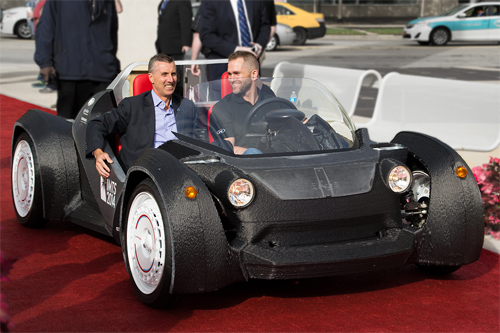 Local Motors, a technology company based in Phoenix, Arizona, USA, has shown the world a finished automotive product made with 3D printing.
The car, called the Strati, is a two-seater with plastic body parts. It takes about 44 hours to complete on a machine called BAAM (Big Area Additive Manufacturing). The Strati uses an electric motor, battery and suspension from French carmaker Renault, according to the AP. It has a top speed of 40 km/h.
The Strati’s surfaces are very rough compared with the sheet metal used to build cars until now. That comes from the nature of 3D printing, especially at large scale. The BAAM machine lays down thicker layers than ordinary small printers, which is why the Strati looks like a topographic map.
With fewer than 50 main parts and a total weight of about 816 kg, the Strati is also the simplest car to build compared with today’s highly complex car manufacturing.
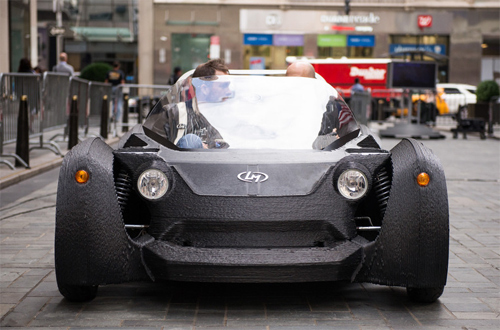
The Strati is the first of 3 models Local Motors plans to bring to market, according to CEO Jay Rogers. The expected price is 18,000 to 30,000 USD. The company also plans to build a small factory at the National Harbor shopping and entertainment complex in Maryland. Construction is waiting on zoning changes, according to the Washington Post.

3D printing had been used in the auto industry before, but only to make individual parts. 3D printing can make everything from fighter jet parts to dentures. The Strati is the first complete car made with this technology, although it is not yet legal to drive on highways.
Source: VnExpress.
The world’s first 3D-printed car model:
Local Motors made a breakthrough in the history of the global auto industry when it launched the first car made with 3D printing. The car, called the Strati, is on display at the International Manufacturing Technology Show (Chicago, USA). Earlier this year, Local Motors held a contest to design cars that could be built with 3D printing. The Strati Concept was the winning design, the brainchild of Italian designer Michele Anoe. The car has 40 parts, most of them 3D printed. The Local Motors team took 30 hours to print the parts and another 14 hours to assemble them. In total, the Strati was finished after 44 hours. So that people could watch how the car was made, the Local Motors team did all this in front of the public at the International Manufacturing Technology Show 2014.
 Local Motors used a large 3D printer, along with some other plastic and carbon components, to complete this special car. The chassis, seats and main parts were printed using Direct Digital Manufacturing (DDM). The car still uses real wiring, suspension and batteries. At first, the car is fitted with an electric motor powered by a battery pack. This motor gives it a top speed of 6.4 km/h. The Strati uses the Renault Twizy powertrain.
Jay Rogers, CEO of Local Motors, added that this speed is slower than a regular bicycle. But he stressed that this is a concept car, and for safety reasons it cannot go faster yet. In the future, Local Motors says the car could reach 64.3 km/h with a range of 193 to 241 km. The Strati will be an option for the daily commute.
Local Motors is also planning a gasoline version of the Strati. It could be priced at around 13,900 to 23,200 USD.
Source: Dan Tri.
3D printing changes the game in car manufacturing:
The first steps:
In recent years, advanced manufacturing technology has become more and more common on production lines, and 3D printing is a key part of that.

Printing an iPhone case on the Cubicon Style 3D printer.
3D printing has had big successes in car and race car research, but its use is still limited. It is just one of several production options. Original equipment manufacturers increasingly favor it for prototypes or small-scale production, but several factors keep it from being used for parts in mass-market cars. These include how mature current 3D printing technology is, the quality of finished parts, process and material costs, and the time needed to print each part. Still, this is a gap that can be closed.
Use in car production:
Neil Oatley, Design and Development Director at McLaren Racing, says the company now uses 3D printing to make small parts such as cooling ducts. “Before 3D printing, it took us several days to make them. Now it only takes about 3 to 4 hours.” In Formula 1, saving time is a huge advantage. McLaren gets this advantage from the very fast development speed of 3D printing. Neil Oatley says the McLaren Racing team often asks for small changes just days, or even hours, before a race. 3D printing has “brought flexibility we never had before.” However, 3D printing still needs lower costs and faster production if it is to be used for mass production of the cars we see on the road.
See what 3D printing is
A promising technology:
Andy Middleton, President of Stratasys EMEA, a maker of 3D printers and 3D production systems, said: In the auto industry, 3D printing will first be used for high-value, low-volume products. The partnership between Stratasys and McLaren is a typical example: low production volume but high value. In January 2017, McLaren Racing and Stratasys announced a new four-year partnership to expand production capacity for the Formula 1 team at the McLaren Technology Centre in Woking, UK. The site provides FDM 3D printing (building parts layer by layer) and PolyJet inkjet printing, used to make many race car parts such as hydraulic lines, rear wing parts and carbon fiber cooling ducts. Right after the expansion, McLaren Racing said it would use these methods to make parts for its 2017 MCL32 race car, to speed up design changes and cut weight.
>> See FDM 3D printers
Contact CT3D Group
CT3D Group – Professional 3D printing, 3D scanning, 3D design and rapid prototyping services nationwide.
- CT3D Thu Duc – Ho Chi Minh City, Hanoi, Hai Phong: in3d.edu.vn – Hotline 0975 008 728 (Mr. Thai)
- CT3D District 6 – Ho Chi Minh City: 3dmaker.vn – Hotline 038 7798308 (Mr. Phuc)
Frequently asked questions
Where is 3D printing used in car manufacturing today?
3D printing is mainly used for design prototypes, jigs, fixtures and inspection tools on the line, and parts for race cars and low-volume vehicles. Some carmakers also use it to make spare parts for older models whose production molds no longer exist.
Why hasn’t 3D printing replaced stamping and molding in mass car production?
At high volumes, metal stamping and injection molding are still much faster and cheaper per part. 3D printing wins when quantities are small, shapes are complex or designs change often, but print speed and material cost are still barriers at mass scale.
What materials are commonly used to 3D print car parts?
Engineering plastics such as ABS, ASA, PA (nylon) and carbon fiber reinforced plastics are common for fixtures and interior parts. For parts that face high heat and loads, carmakers use metal 3D printing with aluminum, stainless steel or titanium.
How can car customization shops use 3D printing?
Custom shops often 3D print prototypes of trim, vents, brackets and raised badges before making them in composite or metal. Combining this with a 3D scan of the original car makes printed parts fit closely and cuts the number of revisions.
Do large 3D-printed parts need extra finishing?
Usually yes. Large-format 3D printing lays down thick layers, so layer lines are visible. Important surfaces need sanding, filling, painting or CNC machining to reach the required smoothness and dimensions.
Related services at CT3D Group
- On-demand 3D printing service
- High-accuracy 3D scanning service
- Custom 3D design service
- CT3D Group network: ct3dgroup.com · in3d.edu.vn – Hotline/Zalo 0975 008 728

