
 Tiếng Việt



Rapid 3D prototyping of models can use high technology or handcraft. Either way, each product needs to be realistic and capture the spirit of the subject. This matters most for rapid 3D prototyping of Catholic statues, Buddhist statues and gift figurines. Once the prototype is perfect, the next step is making a silicone mold and mass producing the product. The process must allow for post-processing and painting, and the statues/products must not shrink during production. There are several ways to make rapid 3D prototypes:Each option is needed to reach the best possible final product, with customer satisfaction as the goal.
- 3D printing for rapid prototyping. With today’s most advanced liquid resin 3D printing, you can make large parts quickly with a good surface finish.
- Clay sculpting by skilled artisans.
Rapid 3D prototyping of models:
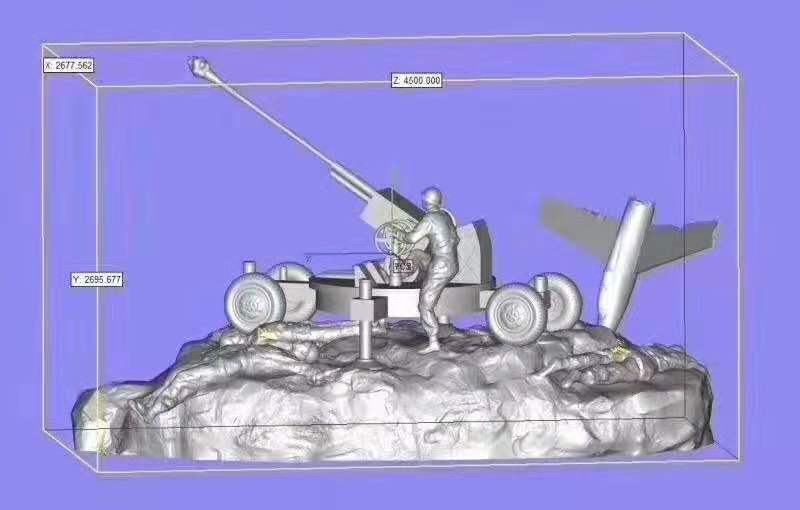
Setting up the part with supports for fast 3D model printing on a 3D printer
<< Silicone mold making service >>

Finishing the product with industrial paint to deliver the final piece.
Applications of 3D model prototyping, silicone mold making and composite production:
- Composite statue production Buddhist statues
- Composite statue production Catholic statues
- Composite gift product manufacturing
- …
Sponsored by Beconi
Beconi Catholic statues / Premium Catholic statues / Catholic statue products / Beconi Catholic statues for sale / Beconi makes Italian-style Catholic statuesTECHNICAL SUPPORT & QUOTES
PHONE: 0975 008 728 (Mr. Thai) / 0985 936 728 (Mr. Dang) EMAIL: contact@ct3dgroup.com / chuyentaomau.comContact CT3D Group
CT3D Group – Professional 3D printing, 3D scanning, design and rapid prototyping services nationwide.
- CT3D Thu Duc – Ho Chi Minh City, Hanoi, Hai Phong: in3d.edu.vn – Hotline 0975 008 728 (Mr. Thai)
- CT3D District 6 – Ho Chi Minh City: 3dmaker.vn – Hotline 038 7798308 (Mr. Phuc)
From 3D model to silicone-cast product
Rapid prototyping is only the first step. To get consistent products in volume, the master model has to go through a controlled series of steps:
- Build the 3D model: digital sculpting or 3D scanning of a clay model or existing statue, then refining details such as faces, clothing folds and patterns.
- Print the master: use resin printing for a smooth surface, or large-format FDM printing for big statues printed in sections and joined.
- Finish the master: remove layer lines, fill, sand and prime. Every flaw on the master will show up in the mold, so this step decides the quality.
- Make the silicone mold: set the parting line, pour the silicone and build a mother mold (rigid shell) to hold the shape during casting.
- Cast the product: pour resin, polyresin, composite or plaster into the mold, let it cure, then demold.
- Post-process and paint: trim flash, sand seam lines, paint and apply a protective coat.
3D printing or hand sculpting: which is better for the master?
| Criteria | 3D printed prototype | Hand sculpted (clay) |
|---|---|---|
| Accuracy, symmetry | High, easy to edit on a computer | Depends on the artisan’s skill |
| Changing scale | Scale up or down quickly from the same file | Must be sculpted again from scratch |
| Artistry, expression | Good when the modeler has digital sculpting experience | Clearly shows the artisan’s personal touch |
| Storage | Save the file and reprint any time | Physical models degrade over time |
In practice, many workshops combine both: an artisan sculpts the model, then it is 3D scanned to digitize it, edited, and printed in different sizes.
Tips for durable silicone molds and shrink-free products
Choose a silicone hardness that suits the level of detail: soft silicone releases undercuts easily, while firmer silicone holds shape better for large models. Vacuum degas the silicone to remove air bubbles, and control the mix ratio and temperature when casting to limit shrinkage. See our silicone mold making service if you need advice on choosing mold and casting materials for your product.
Frequently asked questions
How many parts can a silicone mold usually cast?
It depends on the type of silicone, the complexity of the model and the casting material. Typically it is a few dozen casts, sometimes more if the mold is well cared for. Casting materials that give off a lot of heat, such as some resins, age the mold faster than plaster.
Can a 3D print be used directly as the master for mold making?
Yes, but the print needs careful surface finishing to remove layer lines before molding. If it is not finished, the silicone will copy every layer line and flaw onto all the parts.
Should statues be cast in composite or polyresin?
Polyresin usually gives sharp detail and a smooth surface, which suits small statues and indoor display gifts. Composite has fiber reinforcement, so it is stronger and lighter for large statues or outdoor use.
Can a statue be scaled up from a small model?
Yes. The small model is 3D scanned, scaled up in software, then 3D printed or CNC machined as a large model. When scaling up, extra detail work is needed because small flaws in the original become more visible at a larger size.
Related services at CT3D Group
- On-demand 3D printing service
- High-accuracy 3D scanning service
- Custom 3D design service
- CT3D Group network: ct3dgroup.com · in3d.edu.vn – Hotline/Zalo 0975 008 728

