
 Tiếng Việt



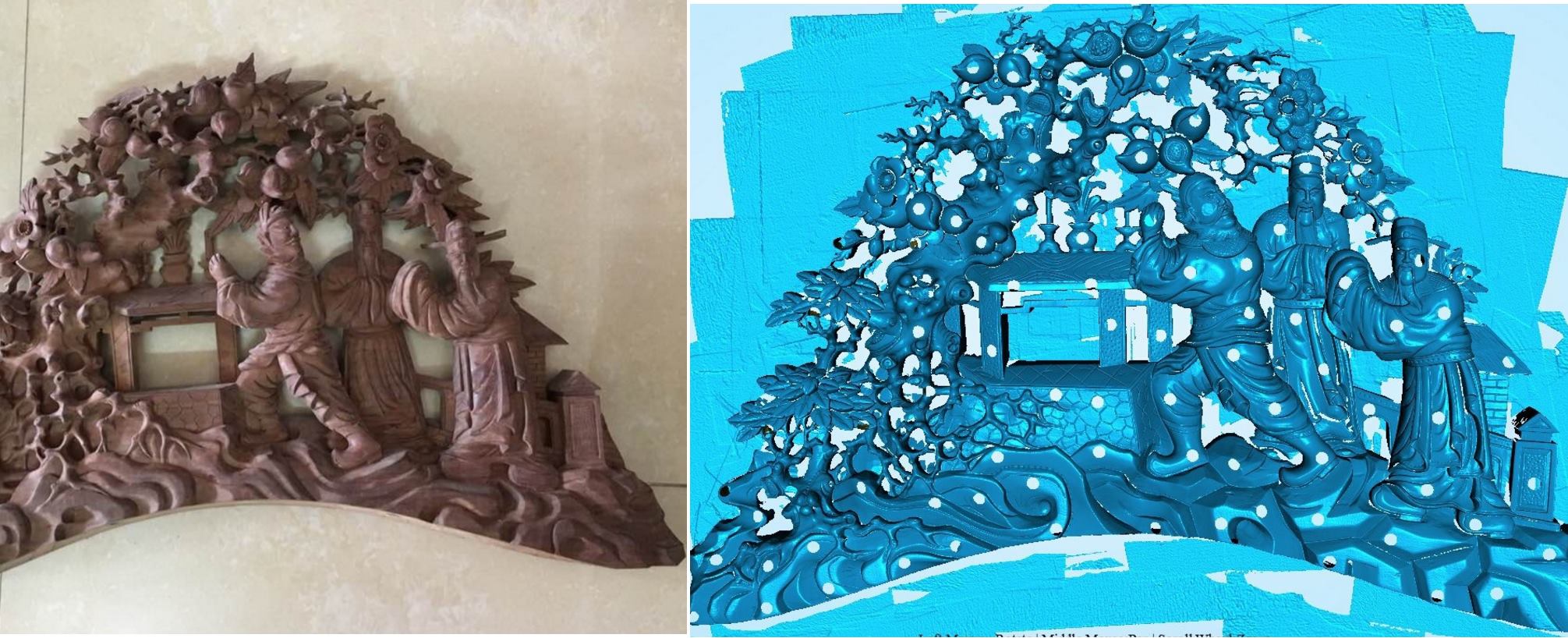
EinScan Pro: a 3D scanner for 2.5D wood carvings and reliefs. Made by Shining 3D.
3D scanner for wood carvings:
A 3D scanner for wood carvings from Shining 3D. For full details, see the manufacturer’s pages: Shining3d.com – or Einscan.com
Zalo/Viber: 0975 008 728 – 0975 008 728

Zalo/Viber: 0975 008 728 – 0975 008 728
Zalo/Viber: 0975 008 728 – 0975 008 728
Optional accessories:
- Tripod and turntable.
- Color Pack (full-color scanning).
TECHNICAL SUPPORT
Zalo/Viber: 0975 008 728 – 0975 008 728
Email: cuong.nguyen@3D Vietnam.vn
| See our | products: | |||
| 3D printing | 3D printers | Affordable 3D printers | 3D scanners | 3D scanning machines |
| SLA 3D printing | FDM 3D printers | 3D printing service | 3D scanning | 3D scanning service |
Contact CT3D Group
CT3D Group – professional 3D printing, 3D scanning, design and rapid prototyping services nationwide.
- CT3D Thu Duc – Ho Chi Minh City, Hanoi, Hai Phong: in3d.edu.vn – Hotline 0975 008 728 (Mr. Thai)
- CT3D District 6 – Ho Chi Minh City: 3dmaker.vn – Hotline 038 7798308 (Mr. Phuc)
2.5D wood carvings and reliefs: what to expect when 3D scanning
A 2.5D wood carving (also called a relief) is carved in raised form on a flat background, unlike a statue that can be viewed from every side. This makes 3D scanning simpler than for a full statue, but it comes with its own challenges:
- Undercuts and deep grooves: pierced carving and overlapping layers of leaves easily create hidden areas the scanner’s light can’t reach.
- Large size, shallow depth: many panels are several meters long but only a few centimeters deep, so you need to stitch many scans without the background bending or shifting.
- Dark, polished wood: it absorbs or reflects light and lowers data quality if left untreated.
Scanning workflow and using relief data
| Step | What it involves |
|---|---|
| 1. Preparation | Remove dust; add markers on large panels; treat surfaces that are too shiny or too dark |
| 2. Scanning | Scan perpendicular to the panel, then add angled passes to capture deep grooves |
| 3. Alignment and processing | Align data, remove noise, fill holes, flatten the background plane |
| 4. Export | STL or OBJ for wood-carving CAM software, 3D printing or archiving |
| 5. Reproduction | CNC machining in wood or stone, or 3D printing masters for composite or bronze casting |
The biggest benefit of digitizing reliefs is that you can rescale, combine or separate individual motifs to create new designs while keeping the spirit of the original. For craft workshops, it is a way to preserve valuable carving patterns without worrying about them deteriorating over time.
If you need to digitize carvings or reliefs but don’t have the equipment, check out our 3D scanning service for wood carvings and reliefs for advice on a scanning approach that fits the size of the piece.
Choosing a scanner for a woodworking shop
- A scanner with both handheld and fixed modes is more flexible when the shop handles large panels as well as small details.
- Match the resolution to the CNC bit size you use. Scanning finer than the machine can cut adds no value.
- Check that the bundled software can export a format your CAM software accepts.
- Choose a supplier that offers training and post-scan data processing support.
Frequently asked questions
How does machining a 2.5D carving differ from a full 3D statue?
A 2.5D carving only has raised features on one side, so it is usually cut on a 3-axis CNC. A full statue needs a 4- or 5-axis machine to carve every side. That is why relief scan data is usually simpler and lighter.
Can I enlarge a small relief from scan data?
Yes. Scan data can be scaled to any size before machining. For large enlargements, scan the original at high resolution and touch up any blurry details.
Does 3D scanning damage antique wood carvings?
No. A structured-light 3D scanner only projects light onto the surface and never touches the piece. If you need markers or matte spray, use types that are easy to remove and wipe off, and test on a hidden area first.
Can relief scan data be used for bronze or composite casting?
Yes. The data can be used to 3D print or CNC a master, then make a silicone mold for casting composite or a pattern for bronze casting. This lets you reproduce a wood piece in many different materials.
Related services at CT3D Group
- 3D scanning service – high-accuracy 3D scanning
- CNC wood and relief cutting
- On-demand 3D printing service
- CT3D Group network: ct3dgroup.com · in3d.edu.vn – Hotline/Zalo 0975 008 728

