
 Tiếng Việt


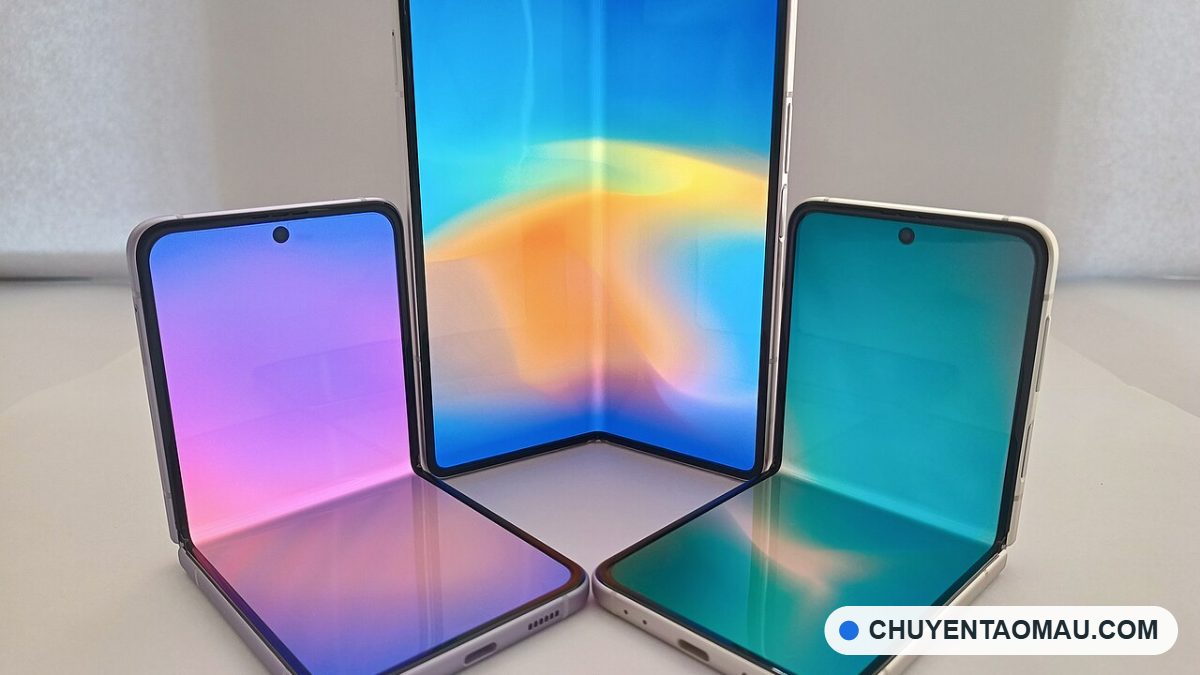
Most of the 3D printing orders our shop gets from the electronics industry are enclosures. Meter housings, controller housings, sensor boxes, PCB brackets. Clients are usually hardware startups or R&D departments that need a few dozen units for testing, not enough to justify an injection mold. For a long time I thought 3D printing in electronics mostly stopped there: prototypes, enclosures and jigs.
Three news items in October 2026 made me rethink that. 3D printing is entering electronics from three directions: mass production of metal components for phones, consumer product design that lets users print their own accessories, and low-cost scientific instruments built right here in Vietnam.
A “super factory” with 400 metal printers for smartphones
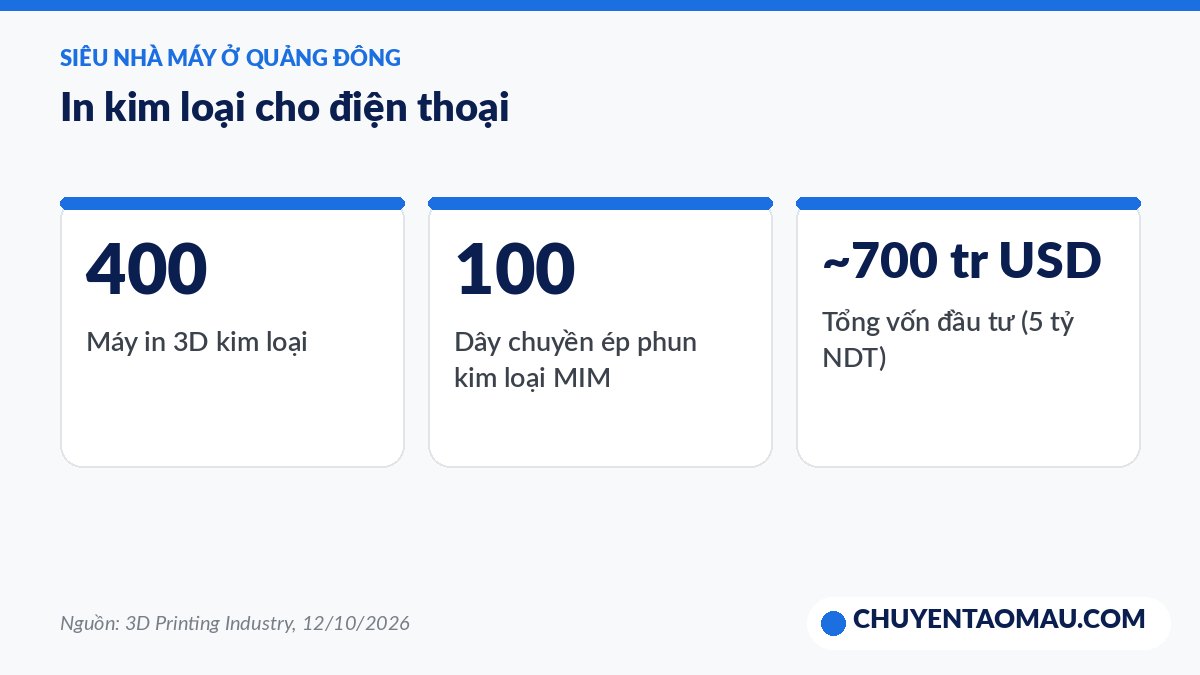
According to 3D Printing Industry (October 12, 2026), a subsidiary of Jingye Steel Group (China) has signed an agreement to build a production facility worth 5 billion yuan (about 700 million USD) in Fengshun County, Guangdong Province. The factory will have 400 metal 3D printers, 20 metal powder production lines and 100 metal injection molding (MIM) lines.
The first products are foldable screen hinges and camera modules for smartphone suppliers. The project has two phases, with 2 billion yuan in phase one, and aims to start partial production before the end of 2026. At full capacity, the factory is expected to reach an output value of 10 billion yuan per year and create more than 1,000 jobs.
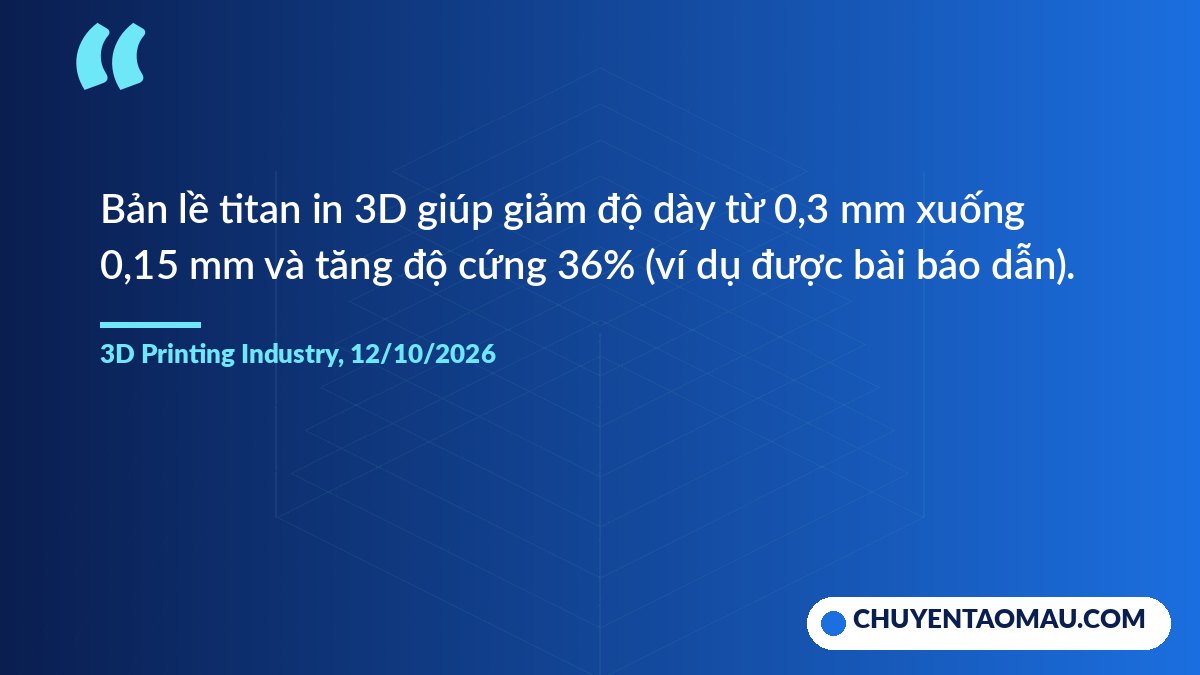
The division of labor inside the factory is worth learning from: MIM makes small parts in high volume, laser printing makes parts with complex geometry, and the metal powder feeds both. The article also cites a 3D printed titanium hinge on an OPPO foldable phone, which cut thickness from 0.3 mm to 0.15 mm and increased stiffness by 36%. A foldable phone hinge is a small part with many internal cavities that needs a strong material. That is exactly the kind of part metal printing does better than traditional machining.
For Vietnam, home to some of the world’s largest phone assembly plants, this news deserves attention from tier 2 and tier 3 component suppliers. Once 3D printed metal parts become standard components in phones, requirements for measurement, fixturing and quality control at the assembly stage will change too.
Nothing speakers: designed for users to print their own knobs and front panels
On the consumer side, 3D Printing Industry (October 15, 2026) reports that Nothing’s CMF brand launched its first two portable speakers, the CMF Speaker S and Speaker M, priced at 59 and 109 USD. The front panel and volume knob come off with a switch on the back. Nothing has also posted a guide on its community site so users can 3D print replacement accessories in the colors they like.
What stands out is that the speakers still meet the IP68 waterproof rating (submerged 1.5 m deep for 30 minutes) despite the removable parts. That means the design team separated the “decorative” parts from the “watertight” parts from the start.
From a product design point of view, I think this is a good lesson for Vietnamese electronics companies. If you want a product “open” for community customization, you must clearly define the mating interface: clip locations, tolerances, contact surfaces. Tolerances for parts printed on home FDM machines must be much looser than for injection molded parts. This is where 3D scanning and test prints pay off: print a few versions, test fit, measure again, then lock in the published dimensions.

A Vietnamese engineer 3D prints a spectral instrument housing to cut costs
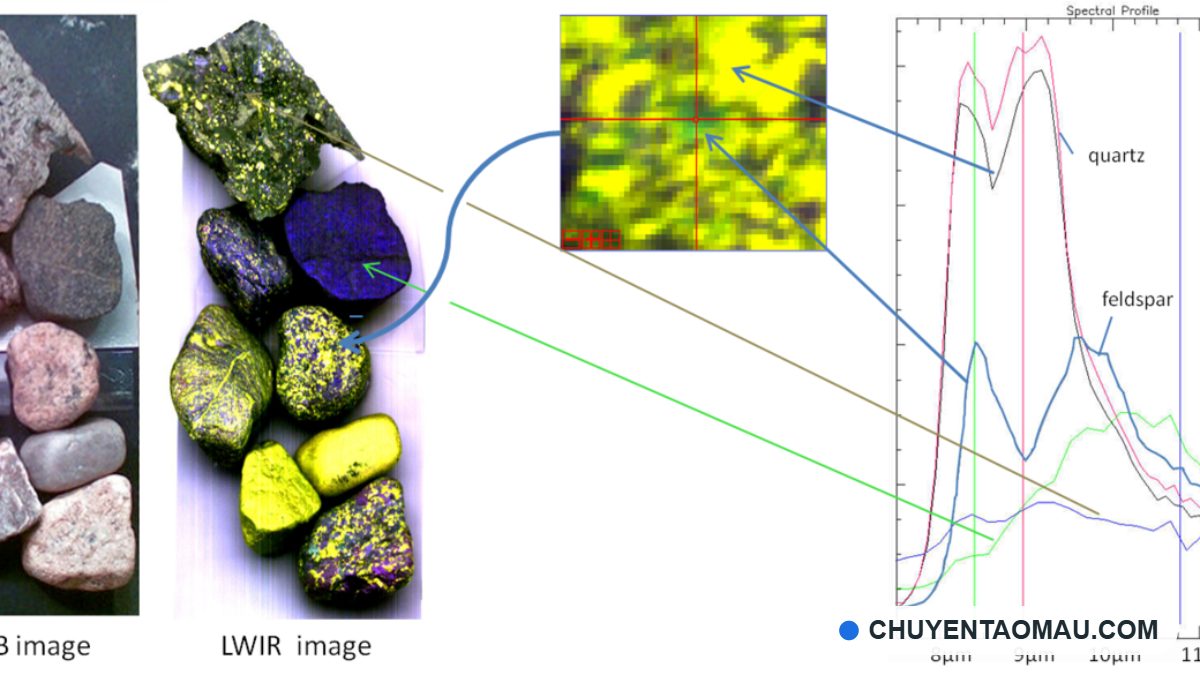
The third item comes from Vietnam and is closest to our daily work. VnExpress (October 16, 2026) featured the C-HySI hyperspectral optical system by Chau Khac Bao Chuong, MSc (RMIT University in Ho Chi Minh City), which won first prize at the 2026 Science Initiative competition. The device includes a hyperspectral camera, data acquisition hardware, analysis software and AI interpretation. It measures water and chlorophyll content and detects early signs of crop stress before the leaves show symptoms.
The detail that caught my eye: to lower costs, the author 3D printed most of the device’s auxiliary components himself. Only core components such as sensors, lenses and microprocessors had to be bought. As a result, the expected cost is only about 30–35% of comparable products once commercialized, while commercial systems often cost hundreds of millions of VND. The device is also designed to handle heat and humidity in the field and can be mounted on a drone.
This story is typical of “made in Vietnam” scientific instruments: the core optics and electronics are bought, while frames, brackets and protective housings are designed and printed in-house. The hardest part is usually moving from a print that works in the lab to a version that survives in the field. That means choosing the right material (ASA, PETG or reinforced nylon instead of PLA) and accounting for thermal expansion and sealing. Once volume reaches a few hundred units, you also need vacuum casting or soft tooling.

Ideas for Vietnamese electronics companies
- Metal component suppliers should look into metal printing for small, complex parts such as hinges, camera frames and heat sinks before their customers start ordering them.
- Product design teams can 3D print prototype housings to test assembly, sealing and hand feel. Do this before opening an injection mold, which costs hundreds of millions of VND.
- Hardware startups and research groups can follow a model like C-HySI: buy the core components, print the rest. When real orders come in, move gradually to vacuum casting.


CT3D Group and In3D.edu.vn for electronic products
CT3D Group designs and 3D prints electronic device housings, assembly jigs and fit-check prototypes, and offers vacuum casting for small batches from a few dozen to a few hundred units. Companies can explore CT3D Group’s rapid prototyping and 3D scanning solutions to shorten the product development cycle. Company information is available on the CT 3D Company profile page.
Engineers and students who want to design device housings for 3D printing and understand fit tolerances can join the design for 3D printing courses at In3D.edu.vn.
Sources: 3D Printing Industry (October 12 and 15, 2026), VnExpress (October 16, 2026).
Compiled by Nguyen Cuong

