
 Tiếng Việt


Five years ago, whenever I introduced metal 3D printing to a machining plant, the first question was always: “Can this print real parts, or just prototypes?” This year, the question has become: “Is printing this part cheaper than machining it, and who certifies it?” The shift in the question mirrors the shift in the technology: metal 3D printing has left the lab and moved onto the production line.

Market data: metal drives growth
According to Q2 2026 data from analyst firm CONTEXT, published by 3D Printing Industry on October 16, global 3D printer revenue rose 31%, with industrial machines up 40%. Metal printers made up 75% of industrial revenue, growing 51%. Powder bed fusion (PBF) accounted for 77% of metal machines shipped.
Chris Connery of CONTEXT summed it up: if you’re making drones, rockets or premium phones, you’re almost certainly using 3D printing as an essential part of the process. These three fields have something in common: complex parts that need to be light, moderate volumes and short product life cycles. That’s exactly the sweet spot for metal 3D printing.
China: 100 printers, 6,300 tonnes of powder a year
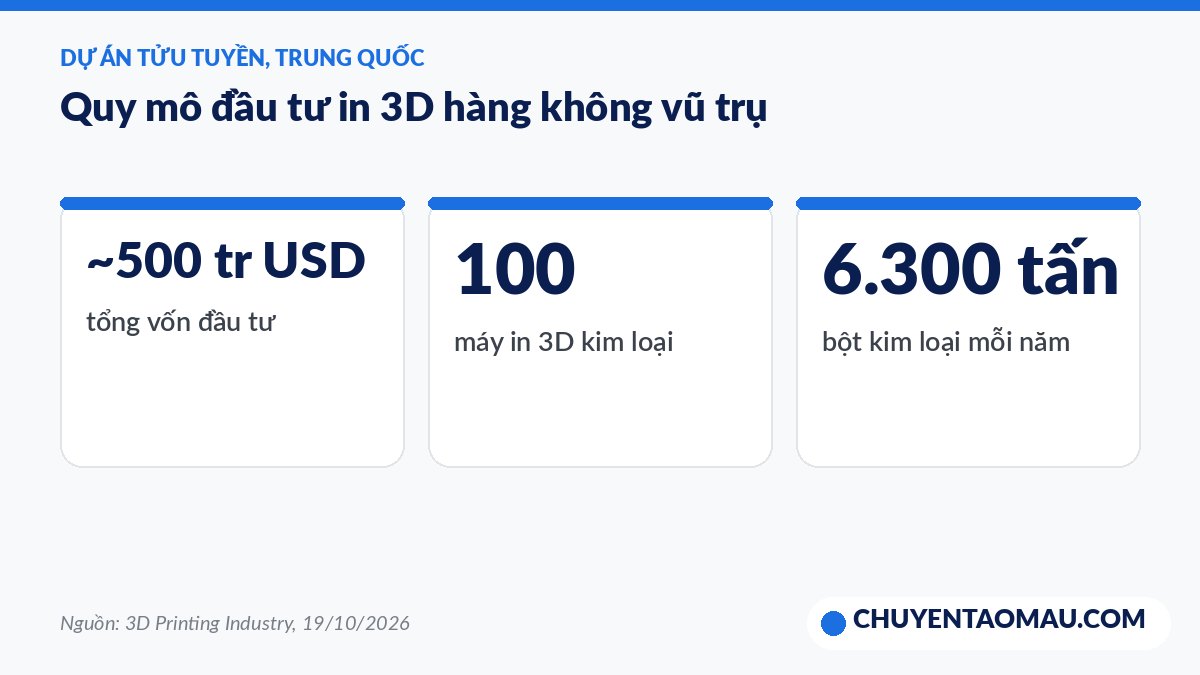
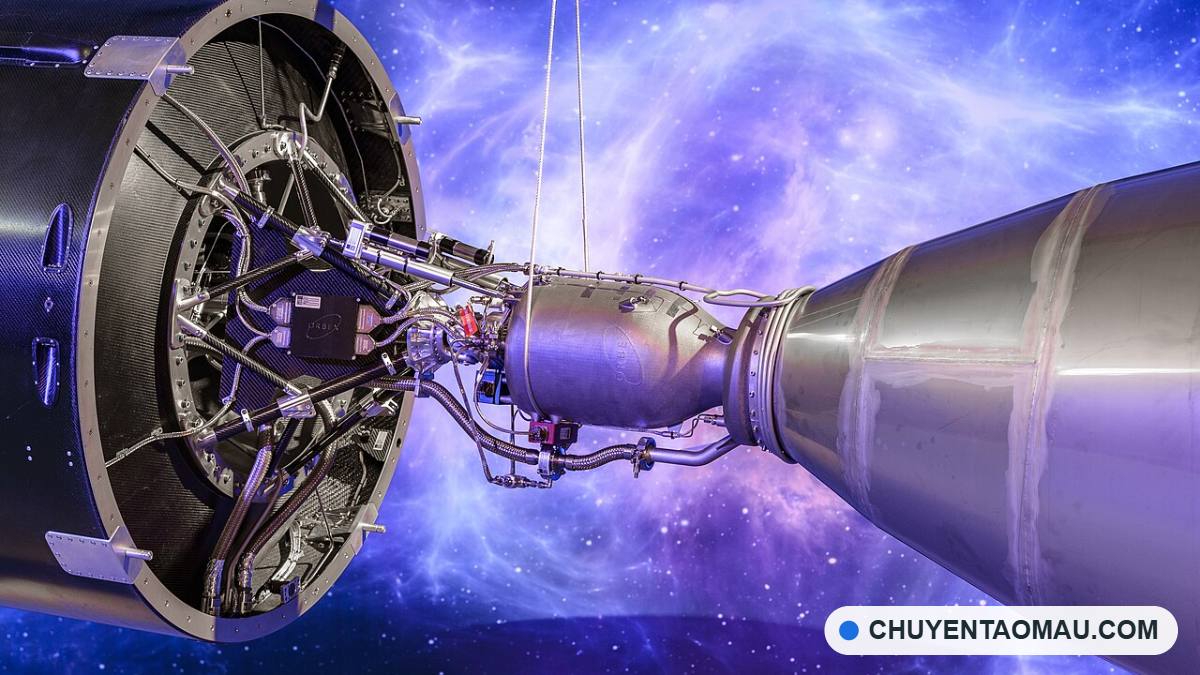
One story shows how big the investments are getting: the city of Jiuquan (Gansu province, China) will break ground on November 1, 2026 on an aerospace project worth about 3 billion yuan (about 500 million USD), according to 3D Printing Industry. The project includes 100 3D printers and 18 metal powder production lines with a capacity of 6,300 tonnes per year, using PREP technology. The main materials are titanium alloys, superalloys and copper alloys for rocket combustion chambers.
What caught my eye is that they make their own powder. For anyone in metal 3D printing, powder is the lifeblood: powder quality (sphericity, particle size distribution, oxygen content) directly determines the mechanical properties of the part. Investing in the whole chain from powder to printer shows they see this as a strategic value chain, not just an equipment purchase.
Vietnam: a “digital warehouse” for the oil and gas industry
At home, a notable signal comes from the energy sector. According to VnExpress, Phan Tu Giang, Deputy General Director of PetroVietnam, said he wants to master metal 3D printing using a “digital warehouse” model: failed parts are printed right at or near the operating site, instead of waiting months for imports.
He also outlined a full workflow: design and simulation, material evaluation, heat treatment, non-destructive testing and certification. He stressed that cooperation isn’t simply about buying equipment. I think this is exactly the right approach, because the hardest part really isn’t the printer.
An engineer’s view: the machine is only 30% of the story
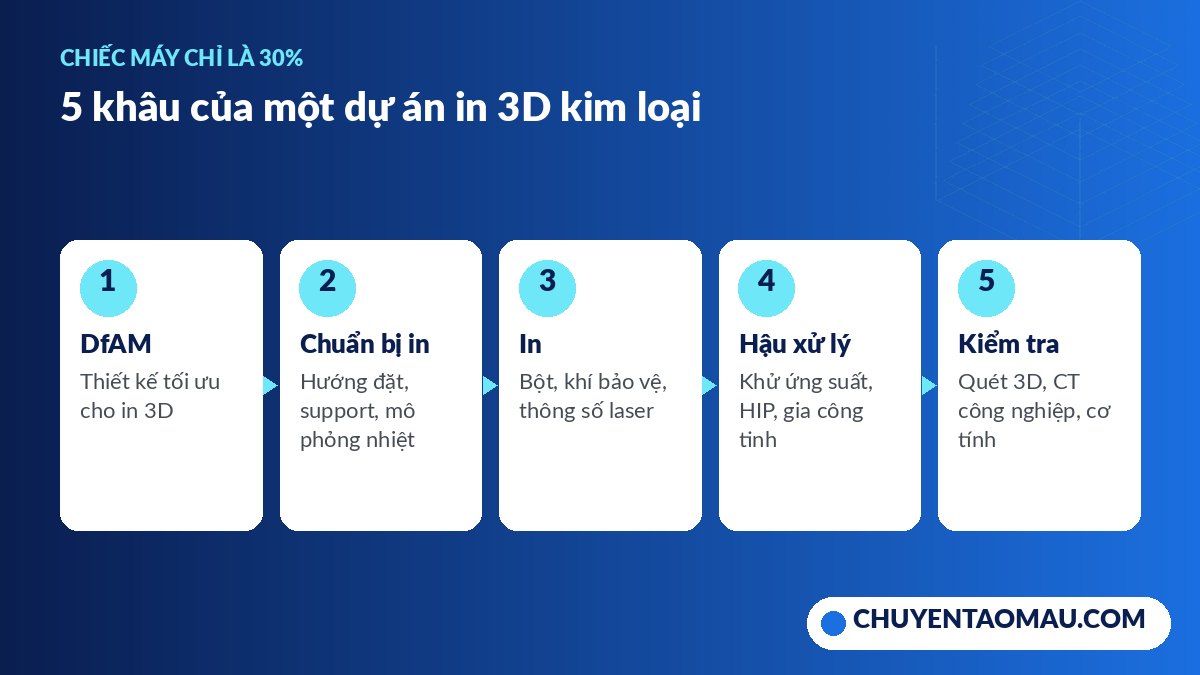
On metal 3D printing projects, I usually split the work into five stages, and the printer is just one of them:
- Design for additive manufacturing (DfAM): a part designed for conventional machining and printed as-is is usually both expensive and fails to use the process’s strengths. You need to optimize the geometry, consolidate several parts into one and route cooling channels inside.
- Print preparation: part orientation, support structures, and thermal stress simulation to prevent warping.
- Printing: control of powder, shielding gas and laser parameters.
- Post-processing: stress relief, hot isostatic pressing (HIP) if needed, removal from the build plate, and finish machining of mating surfaces.
- Inspection and certification: 3D measurement against CAD, industrial CT scanning to find porosity, and mechanical testing on witness coupons.
Across these five stages, 3D scanning and metrology show up at both the start and the end: scanning a failed part for reverse engineering, then scanning the printed part to compare it with the design. That’s why a “digital warehouse” model always has to come with scanning and inspection capability.
An unexpected application: 3D-printed metamaterials
To see what else metal 3D printing makes possible, consider a study reported by VnExpress in July: a 3D-printed aluminum honeycomb lattice makes heat flow around an object, hiding it from infrared cameras. The work was published in Nature Communications. It’s a textbook example of a metamaterial, where the properties come from the geometry and not just the material, and only 3D printing can produce geometry this complex.

Advice for Vietnamese manufacturing companies
If your company is considering metal 3D printing, my advice is not to start by buying a machine. Pick 3–5 parts with real problems: spare parts that are hard to source, parts with complex cooling channels, fixtures that need to be lighter. Use a print service for trial runs, evaluate the results and work out the life-cycle cost. Once you have data and a team that understands the process, the decision to invest in a machine will be much more solid.


About CT3D Group and In3D.edu.vn
CT3D Group works with manufacturers on industrial 3D printing, 3D scanning for reverse engineering and quality inspection projects. CT3D advises on technology selection, design optimization for 3D printing and trial runs before a company decides to invest.
To help your engineering team master design for 3D printing and new production workflows, see the 3D printing training program at In3D.edu.vn, or contact CT3D Group for solution advice.
Metal 3D printing consulting and part inspection: CT 3D Company.
Sources: 3D Printing Industry (Oct 16 and Oct 19, 2026), VnExpress (Sep 13 and Jul 16, 2026).
Compiled by Nguyen Cuong
Frequently asked questions
Is metal 3D printing cheaper than CNC machining?
It depends on the part. For simple geometry and high volumes, CNC machining is usually cheaper and faster. Metal 3D printing pays off when a part has internal channels or lattice structures, when several parts need to be consolidated into one, or when machining would cut away most of the stock.
Which metals are commonly used in 3D printing?
The most common are stainless steels such as 316L and 17-4PH, AlSi10Mg aluminum alloy, Ti6Al4V titanium alloy and nickel-based superalloys such as Inconel. There are also tool steels for molds and copper alloys for heat-dissipating parts. Each material needs its own print parameters and heat treatment process.
Do metal 3D-printed parts need machining after printing?
Usually yes, on some surfaces. Printed metal surfaces are rougher than machined ones, so mating faces, bearing bores and threads are typically left with extra stock and then finish machined. Other surfaces can be bead blasted, polished or left as-is depending on the application.
How is powder bed fusion (PBF) different from wire arc additive manufacturing (WAAM)?
PBF uses a laser or electron beam to melt thin layers of powder one at a time, giving accurate parts, fine detail and complex geometry, but part size is limited by the build chamber. WAAM deposits metal from welding wire with an electric arc. It is fast and can print large parts, but the surface is rough and always needs machining. The two technologies serve different kinds of parts.
What is the maximum size of a metal 3D-printed part?
On powder bed fusion machines, build chambers usually measure a few hundred millimeters per side, and some large industrial machines can go bigger. Oversized parts can be split into sections and welded together, or moved to a metal deposition technology such as WAAM. Discuss dimensions with your print provider from the start to choose the right approach.

